

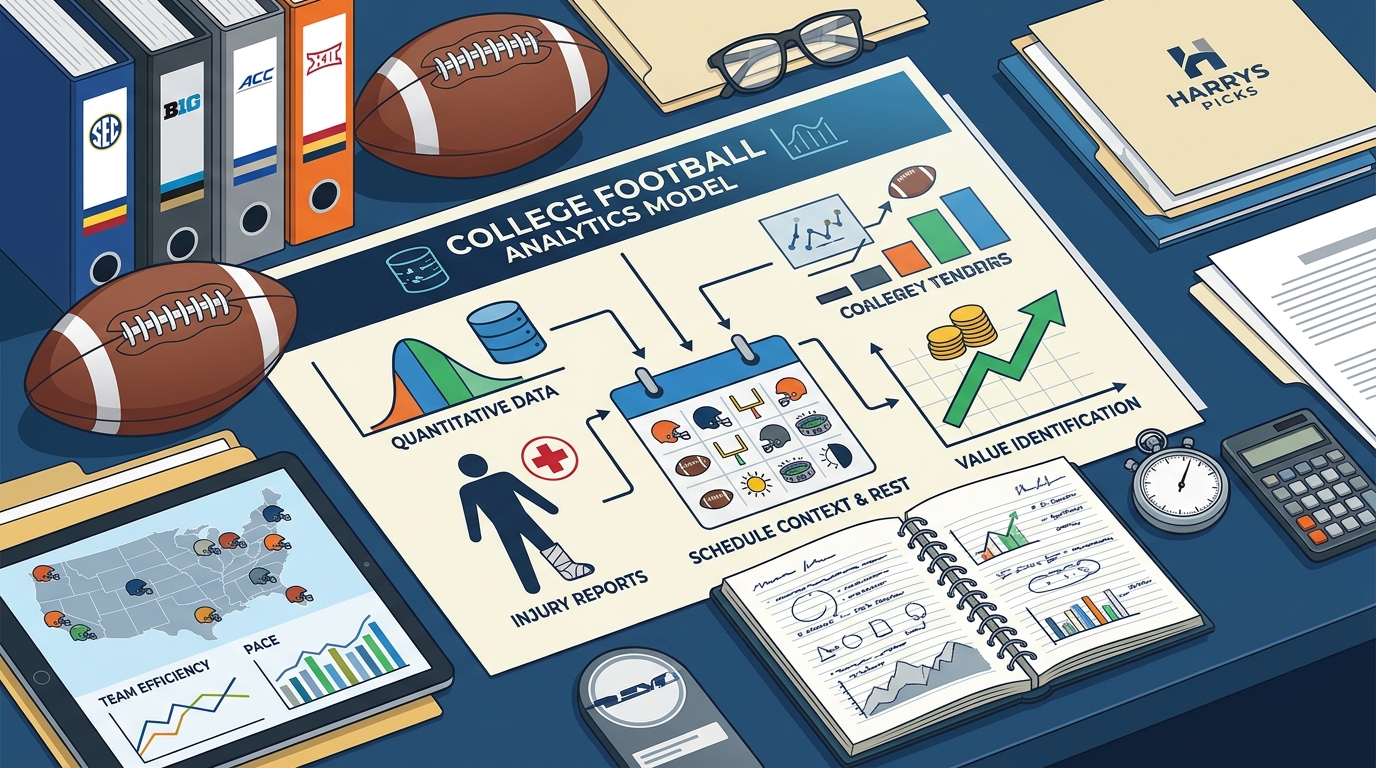
Professional handicappers analyze college football by synthesizing statistical models, injury reports, and schedule context to identify value in the market. They move beyond simple win-loss records to evaluate team efficiency, pace, and rest. This rigorous process helps them predict outcomes with greater accuracy than casual observers. Harrys Picks uses this research-based approach to provide daily insights for fans and bettors.
Statistical Models and Efficiency Metrics
Statistical modeling is the backbone of modern sports analysis. A statistical model is a mathematical framework that processes historical data to forecast future performance. Handicappers rely on metrics like Expected Points Added (EPA) and Success Rate to measure team quality. These numbers reveal how well a team performs in specific game situations, such as third downs or red zone drives.
For example, a team might have a high scoring average but a low efficiency rating, indicating they are getting lucky rather than playing well. By isolating these variables, analysts can predict how a team will perform against different defensive styles. This data-driven approach removes emotional bias from the evaluation process. It allows for a consistent and repeatable method of assessing team strength.
Schedule Context and Rest Factors
Schedule context is a critical variable that often determines the outcome of close games. Schedule context is the analysis of a team's recent games, travel demands, and rest days. College football schedules are notoriously inconsistent, with some teams playing on the road for three weeks while others stay home. Handicappers track these patterns to identify fatigue and travel wear.
Consider a team that played a high-scoring game on Saturday and must travel across the country for a Monday night matchup. The physical toll of travel and the lack of rest can significantly impact performance. Analysts adjust their predictions to account for these external factors. This ensures that the model reflects the true competitive state of the team on game day.
Injury Reports and Roster Availability
Injury reports are a primary source of information for professional handicappers. An injury report is a list of players who are unavailable or limited due to physical ailments. The loss of a key starter, such as a quarterback or a defensive end, can drastically change a team's capabilities. Handicappers monitor these reports daily to update their models and predictions.
For instance, if a team's top running back is listed as out, the offense may become one-dimensional. This forces the defense to focus on stopping the pass, which can open up other vulnerabilities. By tracking availability, analysts can identify mismatches and adjust their expectations for the game. This real-time data is essential for making accurate predictions in a fast-paced sport.
Market Value and Line Movement
Market value is the difference between a handicapper's predicted probability and the implied probability of the betting line. A betting line is the set of odds offered by sportsbooks for a specific game. Handicappers look for discrepancies where the market has mispriced a team's chances. This is where the "edge" is found, allowing for profitable long-term betting.
For example, if a model predicts a team has a 60% chance of winning, but the line implies only a 55% chance, the handicapper has identified value. They will place a bet on the underpriced side. This process requires constant monitoring of line movement and public betting trends. It is a dynamic aspect of handicapping that requires both analytical skill and market awareness.
Responsible Use and Educational Focus
Responsible use is the practice of engaging with sports analysis in a safe and controlled manner. Responsible use is the commitment to treating sports content as educational rather than a guaranteed source of income. Handicappers emphasize that no prediction is certain, and variance is a natural part of sports. They encourage readers to use analysis for entertainment and learning, not as a financial lifeline.
Harrys Picks promotes this mindset by providing clear, research-based content without making exaggerated claims. The goal is to help readers understand the game better and make informed decisions. This approach builds trust and ensures that the content remains useful and ethical. It aligns with the broader mission of providing high-quality sports information.
Key Takeaways
- Statistical models use efficiency metrics to measure true team performance beyond win-loss records.
- Schedule context includes travel and rest, which are critical factors in predicting game outcomes.
- Injury reports provide real-time data on roster availability that can shift game dynamics.
- Market value is identified by comparing model predictions with sportsbook line implications.
- Responsible use emphasizes that sports analysis is for education and entertainment, not guaranteed profit.
- Professional handicappers combine multiple data points to create a comprehensive view of each matchup.
Frequently Asked Questions
What is the most important factor in college football handicapping?
There is no single most important factor, but statistical efficiency is often considered the foundation. It provides a consistent measure of team quality that is less volatile than win-loss records. Combining this with schedule context and injury data creates the most robust prediction model.
How do handicappers handle injury news?
Handicappers monitor injury reports daily and update their models accordingly. The impact depends on the player's role and the team's depth. A key starter's absence is weighted more heavily than a bench player's injury.
Can statistical models predict upsets?
Statistical models can identify value in upsets by finding mispriced lines. They do not predict upsets with certainty, but they can highlight games where the underdog has a higher probability than the market suggests.
What is the role of public betting in handicapping?
Public betting trends can influence line movement, but professional handicappers often bet against the public. They look for value that the general public may have missed, rather than following the crowd.
Is sports handicapping a reliable way to make money?
Sports handicapping is not a reliable way to make money for most people. It is a skill-based activity with inherent variance. It should be treated as a form of entertainment and education, not a primary income source.
Conclusion
Professional handicappers use a multi-faceted approach to analyze college football, combining statistical models, schedule context, and market data. This rigorous process allows them to identify value and make informed predictions. Harrys Picks provides this level of research-based analysis to help fans understand the game better. To stay updated with the latest insights, go to our website to sign up for today's free pick.